 F-14/15, Orbit Mall, Civil Lines, Jaipur-302006
 support@thetaxheaven.com
F-14/15, Orbit Mall, Civil Lines, Jaipur-302006 support@thetaxheaven.comStarting a business can be so exciting but the registration procedure can be overwhelming. One of the most frequent questions that people have when starting their own business is whether or not the proprietorship requires separate registration and what the relationship between GST and sole proprietorship is.
The two are entirely different entities. Unlike private limited companies and LLP companies, proprietorship does not have a unique MCA incorporation procedure. There is no need for an application for Certificate of Incorporation or ROC filing just to establish a proprietorship.
Instead, a proprietor receives relevant registrations, such as GST, Udyam Registration, Shop & Establishment registration, or industry-specific licence, depending on the type of business they run. So, if you're searching for a sole proprietorship registration online, the first thing to do is determine the types of registration your business requires.
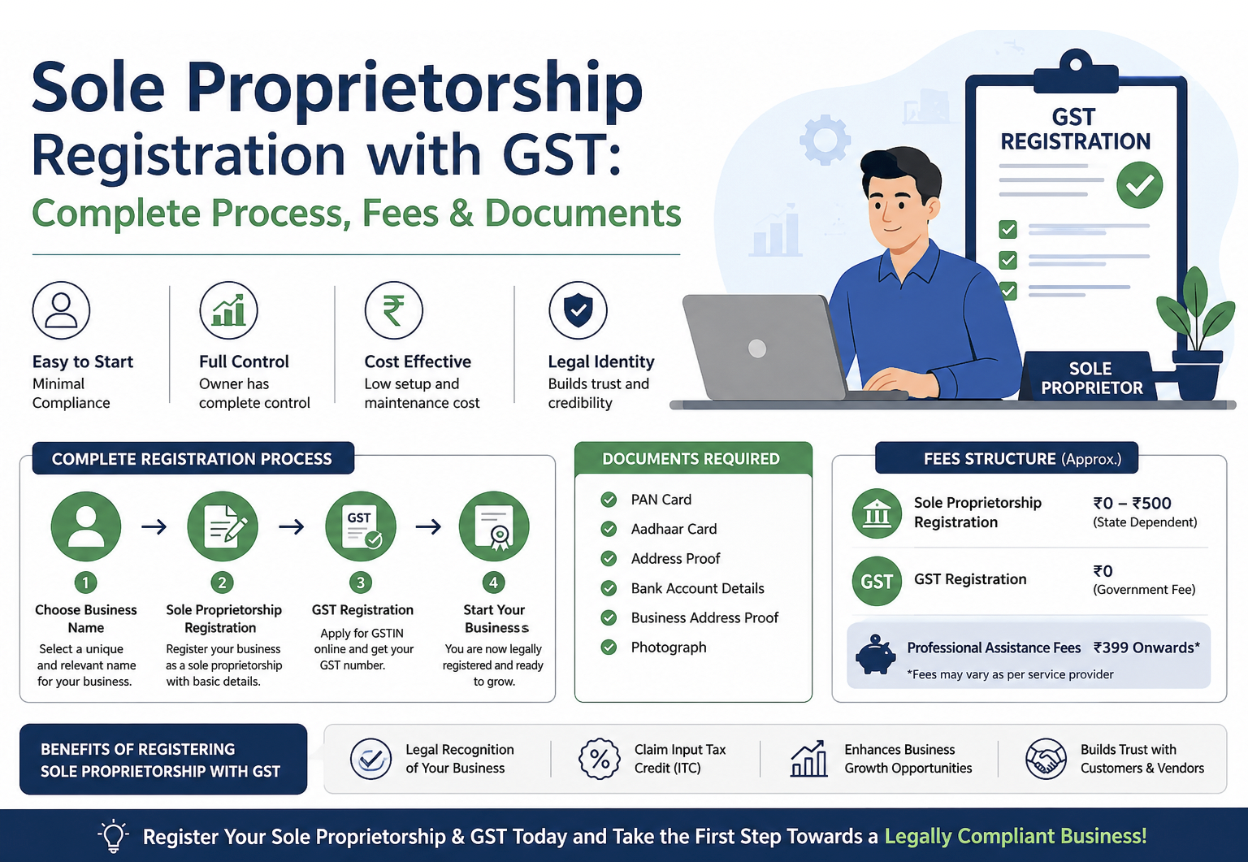
A proprietorship firm registration does not involve obtaining a separate incorporation certificate; rather, it makes use of the proprietor’s own PAN.
Moreover, a proprietorship firm registration does not provide the owner with a separate legal entity. Instead, registrations like GST offer statutory recognition to a business without providing it with a separate legal entity.
When making a choice between proprietorship registration online and other modes of registration, it is necessary to identify and complete the registrations that are applicable to one’s business.
Every individual proprietorship need not be compulsorily registered under the GST regime.
Whether or not the proprietor is required to register himself depends on factors like total turnover, type of supplies, state of operation, and the existence of any compulsory registration provision.
Sections 22, 23, 24 and 25 of the CGST Act, 2017 provide the broad framework for GST registration. For many businesses, the commonly applicable threshold is ₹40 lakh for suppliers dealing exclusively in goods and ₹20 lakh for suppliers of services. However, this is subject to applicable conditions, state-specific rules and exceptions.
In some cases, a business may be required to register for GST irrespective of the turnover under mandatory GST registration rules. Check your business operations before considering the general turnover test.
Alternatively, you can choose to voluntarily register for GST as per Section 25 to raise GST invoices or claim any input tax credits, if applicable.
The exact documents depend on your business and premises, but these are commonly required:
For the principal place of business, the GST Portal may accept documents such as a property tax receipt, municipal khata copy, electricity bill, rent or lease agreement, consent letter, or other prescribed government documents.
The requirement depends on whether the premises is owned, rented or shared, so you only need the document relevant to your situation. A bank account is not necessarily required at the initial application stage in every case. Requirements can depend on the circumstances and the GST Portal's current process.
There is no single incorporation procedure for a proprietorship. Instead, you set up the business and obtain the registrations relevant to it.
You can operate under your own name or use a trade name for the business.
The proprietor's PAN is generally used for the proprietorship. You do not need a separate PAN simply to establish the business.
Keep valid proof of your principal place of business ready. This will be useful when applying for GST and other registrations.
Depending on what you do, you may need Udyam Registration, Shop & Establishment registration, a trade licence, Professional Tax registration, FSSAI registration, IEC, or another sector-specific approval.
Not every sole proprietor needs all of these. The right registrations depend on your business, turnover, location and industry.
While a separate business account may not always be required initially, keeping business income and expenses separate from personal transactions can make accounting, GST compliance and future audits easier.
Once you've established which registrations you need, the GST application can be completed online through the GST Portal. If you're handling sole proprietorship registration online yourself, the process generally involves the following steps:
Go to Services -> Registration -> New Registration.
Provide your state/UT, district, legal name as per PAN, PAN, email address, mobile number, and applicable taxpayer and constitution details.
Complete OTP verification. A Temporary Reference Number (TRN) will be generated so you can continue the application later.
Log in using the TRN and provide information about the business, proprietor, authorised signatory, principal place of business, additional places of business, goods or services supplied, and other applicable details.
Upload the relevant documents in the prescribed format.
For a proprietorship, the proprietor is generally the primary authorised signatory for Aadhaar authentication. Depending on the verification route, this may involve OTP-based authentication or biometric verification at a GST Suvidha Kendra (GSK).
Complete the applicable electronic verification or signing process and submit the application.
After submission, use the Application Reference Number (ARN) to check your application status.
If the tax officer asks for additional information or documents, respond through the GST Portal within the prescribed period.
Once approved, your GSTIN and registration certificate will be available through the portal.
One advantage of starting a proprietorship is that the basic registration costs can be relatively low.
GST registration through the GST Portal does not have a government application fee. Udyam Registration is also free of government charges.
Other registrations, including certain state-level Shop & Establishment registrations and industry-specific licences, may have separate government fees.
If you hire a CA, lawyer or professional registration service, you may also pay professional fees. These are separate from government charges and depend on the scope of assistance provided.
Getting a GSTIN is not the end of the process. It also brings ongoing compliance responsibilities.
You may need to:
The returns and filing frequency can vary based on your turnover, GST scheme and nature of supplies. Make sure you follow the requirements applicable to your specific registration.
Starting a business should not mean spending hours figuring out which form to fill out or which document goes where. Zolvit simplifies the process by helping you identify the registrations that may apply to your business and assisting with the GST application from start to finish.
With Zolvit, you get:
If you're planning sole proprietorship registration online, getting the right guidance at the beginning can save you from unnecessary paperwork and avoidable delays.
Start Your Sole Proprietorship & GST Registration with Zolvit ->
Setting up a sole proprietorship is quite straightforward, however, the type of registrations that you have to make will depend on the nature of the business, your turnovers, and many other factors that might apply to your case. It is possible that you might have to register for GST, but there are many other things too that matter.

 Register & Login