 F-14/15, Orbit Mall, Civil Lines, Jaipur-302006
 support@thetaxheaven.com
F-14/15, Orbit Mall, Civil Lines, Jaipur-302006 support@thetaxheaven.com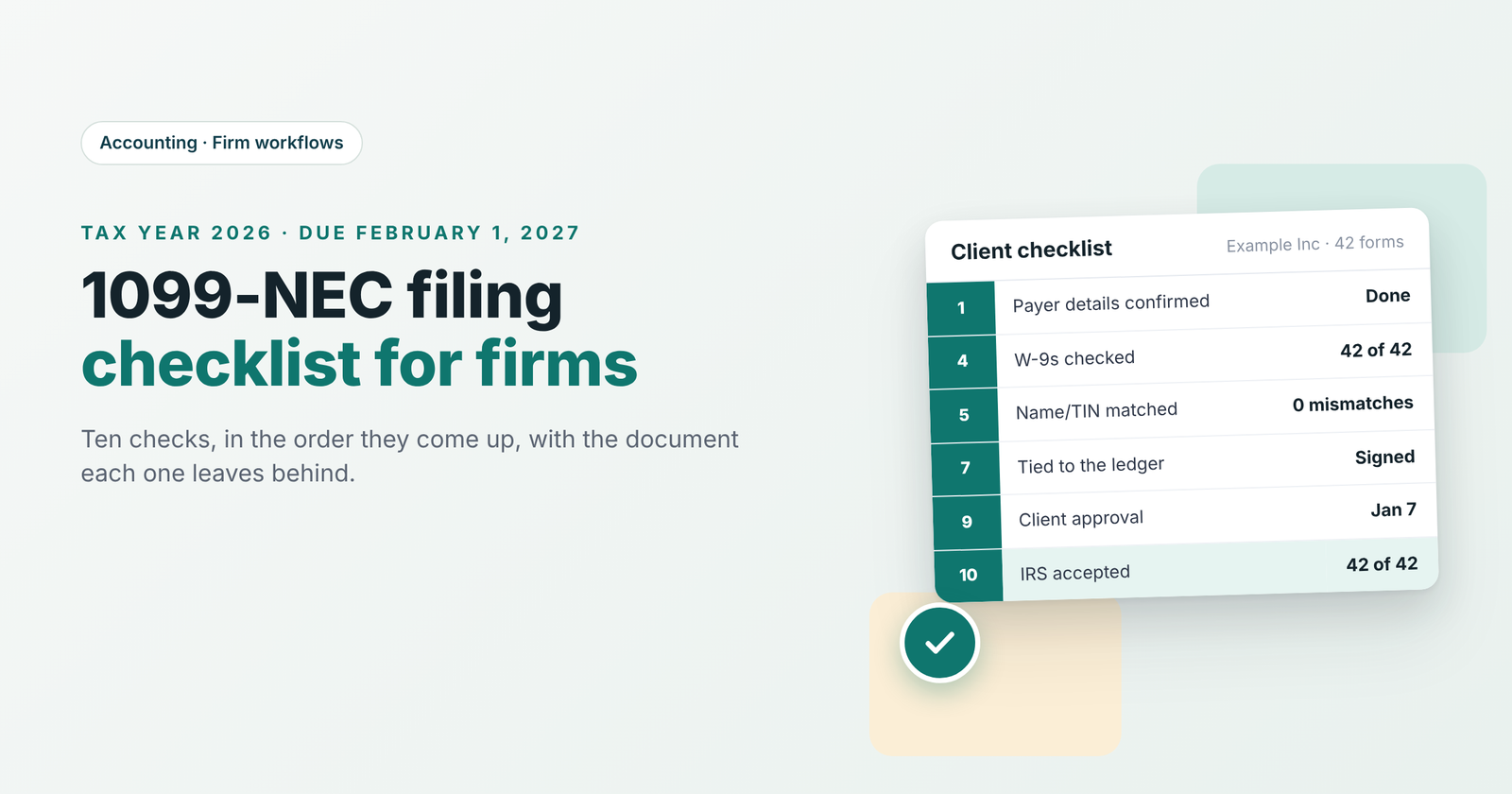
Many Indian Accountants, Tax Pros and CPA firms currently support clients from United States. Filling Information return with IRS is one of the core tax compliance works for the accountants. Form 1099-NEC is the information return a business files for each person or unincorporated business it paid $2,000 or more for services during the year, and for tax year 2026 it is due to both the IRS and the recipient on Monday, February 1, 2027. The form itself is simple. The hard part for an accounting firm is doing the same thing correctly for every client, with data the clients supply late and incompletely. The checklist below is the one we would hand a new preparer: ten checks, in the order they come up, with the figure or document each one produces.
In this article
1. What is different for tax year 2026
6. Sources
The threshold, the due date and the e-file channel have all changed since last season; a checklist rolled forward from a prior year gets each one wrong.
• The threshold is $2,000, not $600. For payments made after December 31, 2025, Form 1099-NEC is required when a payee receives $2,000 or more in the calendar year. The figure will be indexed for inflation in later years. Vendors paid between $600 and $1,999 no longer get a form, unless backup withholding was taken.
• The deadline is Monday, February 1, 2027. January 31 falls on a Sunday, so the due date moves to the next business day. The IRS copy and the recipient copy are due the same day, and there is no automatic extension for the NEC.
• IRIS is the only IRS e-file channel. The FIRE system takes its last filings on November 19, 2026, and from January 1, 2027, information returns are filed electronically through IRIS alone. Any filer with 10 or more information returns of any type, counted together, must e-file.
Each check ends with something the next one can rely on. Keep the output, not just a check mark: a vendor list with a status column, a signed reconciliation, a client's approval email. That is what gets a firm through a client's question in March or a penalty notice in October.
Every form carries the client's legal name, EIN and address, so an error here is an error on every form. Take the legal name and EIN from a prior-year filing or an IRS notice, not from an email or the letterhead, and check whether the client has more than one filing entity, because each is a separate payer. Output: a reviewed payer record with the source of the EIN noted.
Export every vendor paid during the calendar year, by payment date, and flag those at or above $2,000. A list rolled forward from last year misses new vendors and keeps vendors who fell below the new threshold. Two refinements: exclude payments made by credit card or through a payment app, because the card company or platform reports those on Form 1099-K; and pull royalty accounts separately, since royalties go on the 1099-MISC at $10, not on the NEC. Output: the candidate list, with amounts.
Payments to a C corporation or S corporation are generally exempt from 1099-NEC reporting, with two exceptions that catch firms every year: attorneys' fees and medical and health care payments, which are reported whatever the entity type. The W-9's line 3a is what answers this, so a vendor without a W-9 cannot be marked exempt. Mark exempt vendors as reviewed rather than deleting them, so next year's preparer can see the decision. Output: the list with an exempt flag.
A signed Form W-9 is the only document that gives you all four things the form needs: legal name, TIN, classification and address. Line 1 is a legal name, not a trade name; the most common failure is a DBA on line 1 with an EIN that belongs to a different legal name. The TIN type fits the classification: an individual or sole proprietor uses an SSN (or their own EIN), and a single-member LLC that has not elected corporate treatment uses the owner's name and number, never an EIN issued to the LLC. And the form is signed and dated, because an unsigned W-9 carries no certification. Chase the missing ones now; a vendor asked in October answers in days, a vendor asked in January, months after the last payment, answers in weeks. Output: a W-9 status against every name: received and checked, received with a defect, requested, or not required.
A W-9 can be signed and still wrong. The IRS TIN Matching program, available through e-Services to payers of reportable payments and their agents, lets a firm check name and TIN combinations before filing, in batches of up to 100,000. A mismatch found in November is a phone call to the vendor; the same mismatch found after filing comes back months later as a CP2100 notice and a backup-withholding obligation for the client. Output: a match result and date for each payee.
Nonemployee compensation goes in box 1. That is almost everything a contractor is paid for services, including parts and materials billed with the services. Rent, royalties, prizes, medical payments and gross proceeds paid to an attorney are not NEC items; they go on the 1099-MISC in their own boxes. Box 4 is federal income tax withheld, which applies only where backup withholding was taken. Write the mapping down, one general-ledger account to one form and box, and check the 2026 instructions for any tip-reporting fields added to implement the 2025 tax law, in case a client pays tipped nonemployees. Output: a signed box map.
Pull the year's payments from the mapped accounts by payment date and tie the sum of the draft forms to the ledger, account by account. Form 1099 reports what was paid in the calendar year, so a December invoice paid in January belongs to next year; a reconciliation to the purchase ledger will be wrong by exactly the December accruals. Explain every difference in writing: card payments excluded, reimbursements excluded, a vendor below the threshold, a vendor paid from two accounts. Output: a reconciliation schedule, signed by someone other than the preparer.
Sort the payee list by TIN and by the first word of the name. The vendor set up twice, under a legal name and a DBA, either gets two forms or crosses the threshold on neither record. Check the client's prior-year filings before anything goes out, so a correction is not submitted as a new original. Output: a note of what was merged.
Send the draft as a list: vendor, TIN with the last four digits visible, amount, total. Ask for a written approval that names the batch and the total, and give it a date. This is where clients remember the contractor who incorporated in June and the one they paid from a personal account. Output: the approval email, filed with the batch.
File the clean batch in the first half of January, through IRIS or a provider that transmits through it, and record three counts per client: forms prepared, transmitted, accepted. Until they agree the client is open. IRIS rejects malformed TINs and duplicate records at transmission; it does not test name and TIN combinations, which is why step 5 exists. Clear rejections within the week. Filing on January 15 leaves two weeks for exceptions; filing on the last business day leaves none. Firms that file 1099-NEC online through a IRS authorized e-filing platform like taxformhero.com see the acknowledgement per form, so the three counts come from the system rather than a spreadsheet. Output: a dated status line per client.
|
Check |
What it confirms |
Output |
|
1. Payer details |
Legal name, EIN and address from IRS records; one payer per entity |
Reviewed payer record |
|
2. Payee list |
Everyone paid $2,000+ by payment date; card and app payments excluded; royalties pulled separately |
Candidate list with amounts |
|
3. Exemptions |
Corporations exempt, except attorneys' fees and medical payments |
Exempt flag per vendor |
|
4. W-9s |
Legal name on line 1; TIN type fits line 3a; signed and dated |
W-9 status per vendor |
|
5. TIN matching |
Name/TIN combinations agree with IRS records |
Match result and date |
|
6. Box map |
Each GL account to a form and box; MISC items kept off the NEC |
Signed box map |
|
7. Reconciliation |
Draft totals tie to the ledger by payment date; differences explained |
Signed schedule |
|
8. Duplicates |
One record per payee; no correction filed as an original |
Merge note |
|
9. Client approval |
Client has seen and approved the batch and total |
Approval email |
|
10. Filing status |
Prepared = transmitted = accepted, before February 1, 2027 |
Dated status line |
For returns required to be filed in 2027, the IRS penalty for a late or incorrect information return is $340 per form, plus another $340 if the payee statement was also wrong. Correcting within 30 days of the due date reduces each to $60; correcting by August 1 reduces each to $130. Intentional disregard starts at $690 per form with no annual cap. The cost of the same mistake rises as every month it goes unfixed, which is the argument for doing checks 4 and 5 in the fall instead of discovering the problem on notice the following year. A documented history of W-9 requests and TIN checks is also what supports a reasonable-cause waiver if a penalty is proposed.
$2,000 in payments to a payee during the calendar year, for payments made after December 31, 2025, up from $600. Backup withholding is reported whatever the amount.
Monday, February 1, 2027, to the IRS and to the recipient. January 31, 2027 is a Sunday, so the date moves to the next business day. There is no automatic extension.
A client filing 10 or more information returns of any type in the year must e-file. In practice a firm filing for several clients e-files all of them through IRIS, directly or through a provider.
No. Payments by card or through a third-party payment platform are reported by the card company or platform on Form 1099-K. Including them on the NEC reports the same income twice.
Document each request, file with the information held, and apply backup withholding at 24 percent to every reportable payment made to a payee who has not furnished a TIN, from the first such payment. The IRS solicitation rules, an initial request and up to two annual follow-ups, are what support reasonable cause.
• IRS, Instructions for Forms 1099-MISC and 1099-NEC
• IRS, General Instructions for Certain Information Returns
• IRS, Form W-9 and Instructions for the Requester of Form W-9
• IRS, Taxpayer Identification Number (TIN) Matching
• IRS, Publication 1281, Backup Withholding for Missing and Incorrect Name/TINs
• IRS, Revenue Procedure 2025-32 (penalty amounts for returns due in 2027)
• IRS, Filing Information Returns Electronically (FIRE)
• IRS, E-file Forms 1099 with IRIS

 Register & Login
