 F-14/15, Orbit Mall, Civil Lines, Jaipur-302006
 support@thetaxheaven.com
F-14/15, Orbit Mall, Civil Lines, Jaipur-302006 support@thetaxheaven.com
Walk into most older private high schools or university campus buildings, and you see the exact same thing. Hallways are filled with static brass plaques, glass cases housing fading photos, and recognition boards that ran out of empty slots five years ago. Institutions desperately want to honor the people who fund their programs. Yet the physical reality of maintaining those tributes often becomes a serious logistical headache. Space is finite. Engraving takes time and costs money. Eventually, the walls get incredibly cluttered.
Schools have rich histories that should not be forgotten. They also have bright futures that depend heavily on continuous funding and community engagement. Finding a way to balance the past with the future requires moving away from static displays and embracing highly flexible systems.
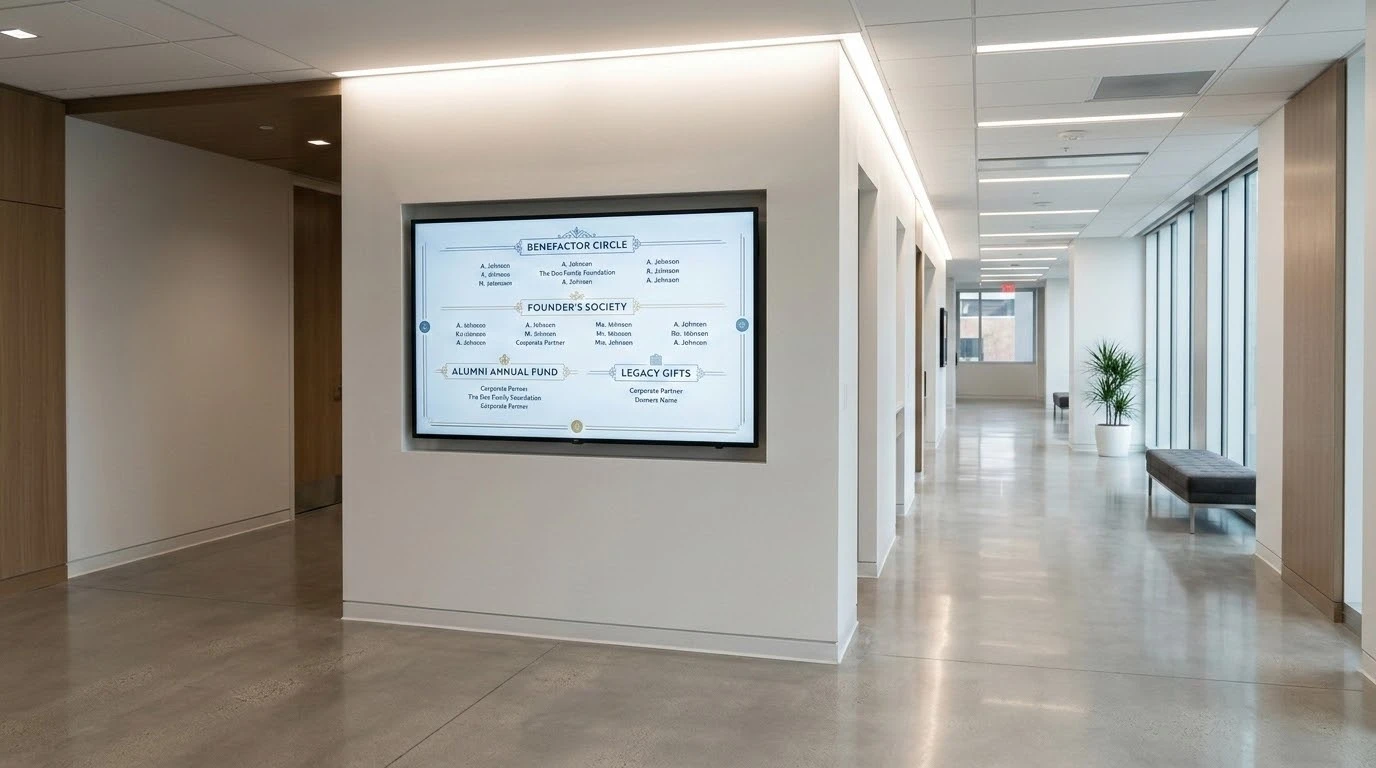
When a school runs out of wall space, the development office has a serious problem. You cannot simply stop recognizing new contributors or skip acknowledging recent fundraising campaigns. The shift to a digital donor wall solves the immediate real estate issue while offering a lot more utility for the staff.
Instead of ordering a new bronze plate and waiting weeks for delivery, administrators use an intuitive content management system to add a name in seconds. This cloud based approach replaces expensive physical hardware updates with simple software inputs. You successfully consolidate space in your hallways and classrooms while keeping historical records entirely intact. It is a massive upgrade over older methods where a misspelled name meant throwing away a costly piece of metal and starting over from scratch.
Institutions often ask about the financial justification when upgrading their legacy systems. Traditional displays represent a sunk cost with ongoing maintenance fees. Every new name requires materials and labor. When a school launches a new annual giving report or a named scholarship, they have to figure out how to physically display it.
With modern interactive touchscreen software, the initial investment covers the hardware and the platform. After that, adding a new tier of giving or updating an impact story costs nothing in physical materials. Schools easily update content over time without needing specialized technical expertise. It keeps the administration focused on building relationships and running campaigns rather than managing vendor orders for engraved plaques. The financial resources saved on physical materials can be redirected into the actual programs the donors are trying to support.
A traditional display relies completely on foot traffic. If a major supporter lives three states away, they only see their recognition when they happen to visit the campus for an event. That drastically limits the impact of the acknowledgment.
When you implement a virtual donor wall, the recognition travels anywhere. Because the database lives in the cloud, alumni and supporters can view the content on their own personal devices. A prospective family checking out the school from their living room gets the exact same seamless experience as someone tapping a screen in the athletic lobby. You can celebrate and recognize anyone from anywhere with a single click. This level of constant access helps attract and retain top talent and recruit future leaders by upholding a highly modern reputation. People like to see their contributions recognized, and giving them a link they can share with family amplifies that goodwill immensely.
Older displays force institutions to be incredibly selective. You only have so much room, so you only recognize the very top tier of achievements or the absolute largest financial gifts. Everyone else gets left off the wall.
Modern software removes those physical boundaries entirely. High performance databases deliver fast access to decades of history without sacrificing speed. A school can feature everything from named scholarships and donor histories to mathlete academic competitions and theater art awards. You give prospective students a comprehensive look at the community they are joining. Touchstone calls this creating a legacy that never graduates, offering an ROI beyond measure by turning past successes into active recruiting tools. You can finally show the full scope of what makes your institution successful instead of just a curated highlight reel.
Public high schools and private universities operate under different pressures, but both face facility constraints. A public high school might prioritize using this technology to centralize announcements, promote local sponsors effectively, and increase general community engagement. Their hallways are often crowded, making space consolidation a major operational win.
Private high schools and universities typically have a different primary objective. Their focus leans heavily toward recruiting exceptional scholar athletes and securing ongoing funding. They need to recognize the contributions of alumni and celebrate traditions in a way that proves their elite status. The right software adapts to either environment. The database structures allow a public school to highlight an entire roster of students while letting a private institution build detailed profiles for major endowment contributors.
Donor recognition does not exist in a vacuum. It is part of the overall school identity. When an institution isolates its giving history from its academic and athletic achievements, it misses a massive opportunity to tell a cohesive story.
Consolidating all of this information into one interactive experience changes how visitors perceive the school. Users can navigate from a gallery of student artwork directly to the alumni game highlights or staff directory. By keeping all these records in one place, you uphold the school's state of the art reputation and compete for championships on a national stage. Prospective students see exactly what is possible, and visiting parents see exactly who helped make it happen.
There was a time when investing in lobby touchscreens meant buying software that would become buggy or outdated a few years later. Hardware would break down and nobody on staff knew how to fix it. Schools ended up with expensive blank monitors sitting in their hallways.
Current platforms are designed differently. They evolve with the institution to provide unmatched flexibility and longevity. They professionalize your image for visitors without requiring an IT degree to maintain. Your development team can manage campaigns and centralize announcements directly from their own desks. The technology does the heavy lifting so the staff can focus on their actual jobs. Gone are the days of worrying about obsolete hardware. You get a reliable tool that works exactly the way you need it to work.


 Register & Login