 F-14/15, Orbit Mall, Civil Lines, Jaipur-302006
 support@thetaxheaven.com
F-14/15, Orbit Mall, Civil Lines, Jaipur-302006 support@thetaxheaven.com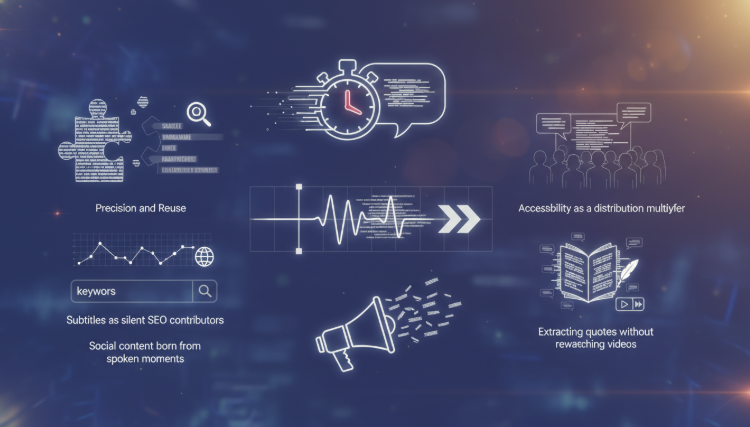
For many creators, subtitles are treated as a final checkbox. Something added just before publishing, often rushed, rarely revisited. Yet in practice, subtitles are one of the few content assets that outlive a single video. They can be searched, quoted, reshaped, and redistributed. The difference lies in how easily those subtitles are generated and reused.
Videos are consumed once. Audio is experienced in real time. Text, on the other hand, accumulates value. It can be scanned weeks later, indexed by search engines, and repurposed across platforms.
Creators usually feel this gap when trying to reuse their own content. Finding a strong quote means scrubbing timelines. Pulling a clean caption requires rewatching. Over time, this friction discourages reuse, even when the content itself is strong.
Subtitles are the bridge between ephemeral audio and persistent content.
Most creators associate subtitles with accessibility or silent viewing. Both matter, but neither explains why subtitles quietly influence so many downstream tasks.
Once subtitles exist as clean text, a video stops being a single artifact. It becomes a source of captions, quotes, summaries, and searchable material. This is where an audio to text converter starts shaping creative output, not just supporting it.
When subtitle generation takes hours, it becomes a chore. When it takes minutes, it becomes part of creation.
Using an audio to text converter that produces SRT files quickly allows creators to review subtitles while the edit is still fresh. This timing matters. Decisions about pacing, emphasis, and clarity are easier to make before mental distance sets in.
Fast subtitles don’t just save time. They preserve creative context.
Creators often accept small subtitle inaccuracies when the captions are only meant for viewing. That tolerance disappears when subtitles are reused as text.
Misheard words break quotes. Loose timestamps make clipping harder. AudioConvert’s second-level timestamp accuracy makes subtitles reliable enough to serve as raw material, not just display text.
Video SEO often focuses on titles and descriptions. Subtitles quietly reinforce both. They provide full linguistic coverage of spoken content, including variations, clarifications, and natural phrasing that titles rarely capture.
Search engines rely on this text to understand context. Over time, accurate subtitles help videos surface for more specific queries without manual keyword insertion.
This happens in the background, which is why creators rarely attribute performance changes to subtitles directly.
Subtitles expand who can consume content. Viewers watching without sound, non-native speakers, and hearing-impaired audiences all benefit.
What’s less obvious is how accessibility affects sharing. Content that is immediately understandable travels further. Subtitles reduce friction at the first few seconds, where most viewers decide whether to stay.
Creators often know they said something valuable, but can’t find it quickly. Subtitles solve this by turning speech into searchable text.
With a full transcript, creators can scan for phrasing that works as pull quotes, thumbnails, or social captions. This process feels more like editing writing than scrubbing video.
Over time, creators build informal quote libraries from their own content, making future promotion easier.
Many high-performing social posts originate from spoken lines rather than written scripts. Subtitles allow creators to lift those lines verbatim, preserving tone and authenticity.
This is especially useful for thought-driven content, interviews, and educational videos where phrasing carries authority.
Long-form content is difficult to revisit, even for its creator. AI summaries help surface structure without replacing nuance.
AudioConvert’s summaries give creators a quick overview of what was covered, making it easier to decide which sections deserve further use. This supports chapter creation, clip selection, and editorial planning.
Summaries don’t replace listening. They reduce the cost of deciding where to listen.
When creators work with editors or social teams, summaries help align understanding quickly. Not everyone needs the full transcript at once.
This keeps collaboration moving without sacrificing transparency.
A single YouTube video can generate subtitles, blog excerpts, newsletter snippets, and social captions. The limiting factor is often how accessible the text is.
AudioConvert’s export options allow creators to move subtitles into different contexts without reprocessing. This supports a system where content is reused intentionally rather than opportunistically.
Once subtitle generation becomes fast, other bottlenecks emerge. Large video files slow down uploads, sharing, and collaboration.
In creator workflows where speed matters, pairing transcription with a simple video compressor helps maintain momentum. Each tool handles a specific task without overlapping responsibilities.
Creators don’t want to learn software. They want output. Tools that feel heavy discourage frequent use.
AudioConvert’s simple interface reduces resistance. Upload, process, export. The lack of friction encourages consistent subtitle generation, which is where long-term value accumulates.
Free tools are often used once and abandoned. AudioConvert’s free access supports repeated use without hidden penalties, which changes behavior.
Creators subtitle older videos, experiment with different caption styles, and explore reuse strategies they would otherwise skip.
Videos age. Subtitles compound. They continue to generate value through search, reuse, and accessibility long after publishing.
An audio to text converter that treats subtitles as reusable material rather than disposable output aligns better with how creators actually work. AudioConvert fits into this reality by making subtitle generation fast, accurate, and flexible.
For creators who see subtitles not as an obligation but as an opportunity, the right transcription tool quietly becomes part of their creative backbone.

 Register & Login